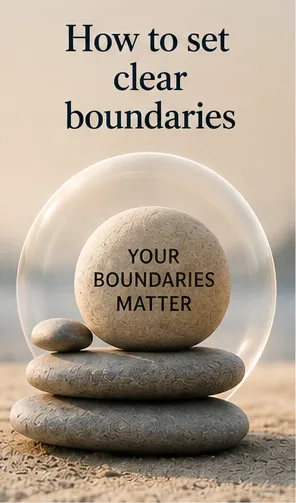
How to set clear boundaries
Boundaries Begin With Awareness
Setting boundaries isn't simply about learning to say no.
For many people, the difficulty lies in understanding why saying no feels so difficult in the first place.
Before automatically reacting, fixing, avoiding or saying yes, pause and ask yourself:
“What am I hoping to get from this?”
Approval?
Acceptance?
Peace?
Validation?
Or simply to avoid someone's disappointment?
This simple question can reveal what is really driving the behaviour.
When Saying No Feels Wrong
If you have spent years keeping the peace, putting others first or being the person everyone can rely on, setting a boundary can feel uncomfortable.
You may feel selfish.
You may feel guilty.
You may worry about disappointing someone.
But discomfort doesn't necessarily mean the boundary is wrong.
Sometimes, it means you are doing something unfamiliar.
Ask yourself:
“What am I afraid will happen if I say no?”
The answer can reveal an underlying belief:
“Everyone else comes first.”
“Good people don't disappoint others.”
“I have to keep everyone happy.”
“If I say no, I will be rejected.”
These beliefs may once have helped you adapt, belong or feel safe.
But what protected you then may be restricting you now.
A Boundary Is About You
A boundary is not about controlling another person's behaviour.
It is about becoming clear about what you will and won't participate in and what you are willing to do.
Instead of:
“You need to stop speaking to me like that.”
You might say:
“If the conversation becomes disrespectful, I will step away and return to it when we can speak calmly.”
You cannot control their response.
You can control your own.
And sometimes, the boundary you most need to set is with yourself:
I will pause before automatically saying yes.
I will listen when something doesn't feel right.
I will take responsibility for what is mine without taking responsibility for everything.
I will no longer abandon myself simply to keep someone else comfortable.
What Are You Really Responding To?
Sometimes the boundary we struggle to set points towards something deeper.
Perhaps you learned that your needs came second.
Perhaps asking for help felt unsafe.
Perhaps keeping everyone happy became a way of maintaining connection.
Perhaps guilt became easier to tolerate than the possibility of disappointing someone.
This is where awareness becomes powerful.
You begin to recognise that your reaction may not simply be about what is happening now.
It may also be connected to what you learned then.
And once you can see the pattern, you have a choice.
You can ask:
“Does this belief still belong to me?”
“Is this how I want to live now?”
Healthy boundaries aren't about becoming harder or caring less about others.
They are about becoming honest enough with yourself to know what is yours to carry — and what isn't.
If setting boundaries continues to feel difficult despite knowing what you want to say, there may be something beneath the boundary itself that is asking to be understood.
That is where the deeper work begins.
Seeing creates choice.
Choice creates freedom.